
Federal Release Routes From Crockett
A person arrested in or tied to Crockett County can leave the county jail without entering the community. If a federal court remands the person, USMS may arrange detention in a local, state, or private facility. That contract bed may be far from Ozona and is not necessarily operated by BOP. After sentencing, USMS can deliver the person to a BOP institution selected through the federal designation process.
The research sweep found no federal prison physically located in Crockett County. Searching only by distance from Ozona can therefore miss the correct record. Begin with the federal case and known prisoner identifier, then follow each custodian in chronological order.
| Federal stage | Record owner | What to verify |
|---|---|---|
| Federal remand | Federal court and USMS | Custody order and case status |
| Pretrial detention | Actual contract jail | Booking, transfer, or release transaction |
| Sentenced prison term | BOP | Register number, institution, and release date |
| Supervised release | Sentencing court and U.S. Probation | Term and current court orders |
| Immigration transfer | ICE | Separate civil detention status |
Search BOP Federal Release Records
Open the official BOP inmate locator. Search by BOP register number when it is known. The identifier route also accepts DCDC, FBI, and INS numbers. Without a number, use the person’s name and available race, sex, and age filters. Compare all returned identifiers and demographics; a name match alone is not enough.
BOP search results can show the name, register number, age, race, sex, Release Date, and Location or status. According to BOP’s record explanation, the locator generally includes federal prisoners released after 1982, subject to stated data limits. Unlike TDCJ’s current-only public form, BOP can retain former-prisoner entries, which makes it useful for a historical federal release check.
The official locator pictured below shows the federal identifier and name-search routes.
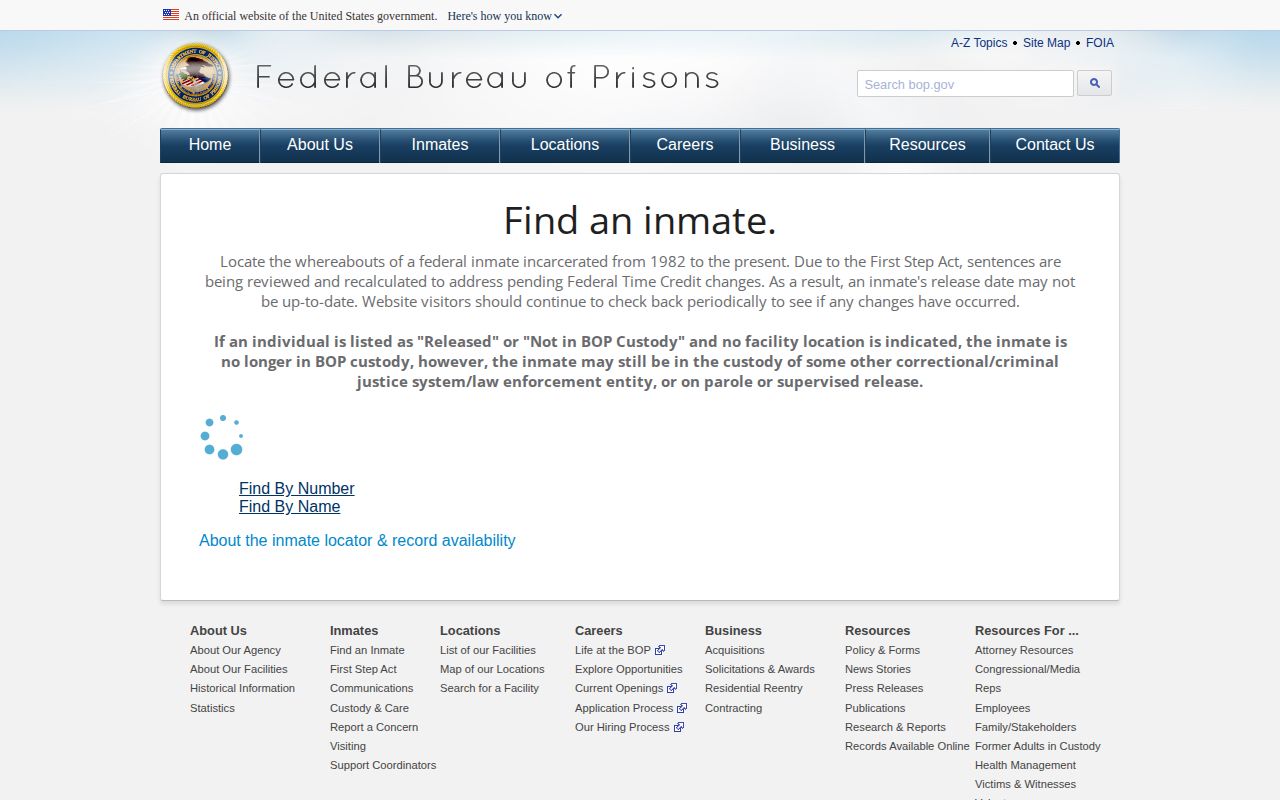
Use the result as BOP’s custody record, then compare it with the federal docket before drawing a conclusion about the sentence or later supervision.
Read a BOP Federal Release Date
A past Release Date paired with a released or no-facility status means the person departed BOP custody according to the BOP locator record explanation. It does not prove that every form of legal control ended. Federal supervised release may begin after prison. A state warrant, state detainer, immigration transfer, or later charge may also change the person’s status.
A future date is not an actual gate-release confirmation. Sentence-credit calculations and other lawful changes can alter a projected federal date. Preserve the label and the date as BOP displays them, note the date of the search, and check again with the record owner when precision is needed.
- Register number
- The BOP identifier used to distinguish one federal prisoner from another.
- Release Date
- A result field that may be historical or future depending on the record and search date.
- Location
- The BOP institution or released-status description associated with the result.
- Not in BOP custody
- A limit on BOP custody only, not a statement about every other agency or supervision term.
A BOP release date confirms departure from BOP custody only; check the docket and any next custodian.
Crockett Federal Release Chronology
The federal docket supplies the legal frame that a locator result cannot. It can show the charging document, detention or release order, plea, judgment, prison sentence, supervised-release term, later modification, and revocation proceedings. The docket date for an order is not necessarily the time the holding jail processed a physical departure.
Build the timeline in source order. Start with arrest and initial appearance. Add the remand or release order, the actual jail booking, any USMS transfer, the federal judgment, BOP intake, the BOP release date, and the start of supervised release. If an ICE or state transfer followed, add that receiving event without calling it community release.
- Collect the full legal name, known variants, date of birth, federal case number, and any BOP, FBI, DCDC, or INS number.
- Review the federal docket for the detention decision, judgment, sentence, and later orders.
- Ask the known pretrial holding facility for its own release or transfer transaction.
- Use BOP only if the person entered or may have entered the sentenced federal prison system.
- Follow any named state or immigration custodian in its own system.
This sequence matters in Crockett County because a person can leave the county jail for federal custody before BOP has any locator record. A no-result during that stage says little about whether USMS still holds responsibility.
USMS and BOP Release Boundaries
The United States Marshals Service prisoner-operations page explains its responsibility for many federal prisoners from court remand through acquittal or delivery to a designated BOP institution. Most federal pre-sentence prisoners are held in state, local, or private facilities. USMS does not publish a former-prisoner search comparable to BOP’s locator.
If a federal defendant was held at Crockett County Jail, obtain the federal court order and ask the sheriff for the local booking, release, or transfer transaction. If another contract jail held the person, that facility owns its transaction. Use the federal docket and the appropriate USMS district contact when the detention site is unknown. Only after a BOP commitment should the federal prison locator be expected to carry the sentenced-custody record.
These boundaries prevent two common errors. A local jail departure to USMS is not freedom from custody. A BOP no-match does not prove a pretrial defendant was released, because the person may never have entered BOP’s sentenced population.
Federal Release and Supervision
Federal supervised release is imposed by the sentencing court and generally follows the prison term. A BOP status showing release from prison does not mean the court’s supervision term has ended. Review the judgment for its length and conditions, then use the sentencing court or its U.S. Probation channel for later public court orders.
A revocation can produce another custody cycle. Keep the original BOP release date separate from a later warrant, revocation judgment, or return to prison. Likewise, do not describe federal supervised release as Texas parole. The Texas Board of Pardons and Paroles and TDCJ Parole Division handle Texas state cases, not federal sentences.
A county criminal docket also cannot replace a federal docket. If Crockett County records mention only a federal hold or transfer, use that clue to locate the correct federal cause. The Crockett County released-person search guide separates local, state, federal, and immigration systems when the next destination is unclear.
ICE After a BOP Federal Release
Immigration detention is a separate civil custody system. If BOP releases a person to ICE, the BOP date establishes an end to federal prison custody while ICE custody begins. Do not describe that handoff as release to the community. The same warning applies when the Crockett County Jail lists ICE as the receiving agency.
Use the ICE Online Detainee Locator with a nine-digit A-number and country of birth when known. Its biographical route uses exact name and country of birth, with date of birth where offered. The official resource says the locator covers current detention and may include releases within the preceding 60 days, can lag, and does not display every person. Records for minors are not available through the ordinary interface.
ICE lists the Detention Reporting and Information Line at 1-888-351-4024 during its published weekday hours. A no-match does not prove removal, community release, or location. Compare the BOP entry, ICE result, federal docket, and receiving record as distinct sources.
Older BOP Federal Release Records
BOP’s online coverage generally reaches federal prisoners released after 1982. A missing older case may require a National Archives request using the person’s identity, approximate institution, and prison dates. That archival route addresses historical federal prison custody; it does not replace a court file or a local jail record.
For any period, identity resolution remains central. Compare full name and variants, birth date, register number, federal case number, age, offense, and agency. Do not combine two people because their names resemble each other. When a public screen omits a useful identifier, provide the identifier directly to the custodian rather than publishing a speculative match.
If two records conflict, retain both values with source and access date. The actual holding jail owns its door transaction, the federal court owns its order and judgment, USMS owns its transport role, BOP owns its prison status, and ICE owns immigration custody. Ask the event owner to review its record instead of choosing the result that seems most convenient.
Confirm a Crockett BOP Release
A complete finding should state exactly what was proved. “Released from BOP custody on the displayed date” is narrower and more accurate than saying the person was simply released. Add whether the federal judgment imposed supervised release and whether another documented custodian received the person. If only a future date appears, call it future or projected rather than actual.
When the person started at Crockett County Jail, request the sheriff’s transaction fields, including release type, authority, and destination if maintained. When a federal court ordered release, preserve that order separately from the jail processing time. When BOP later records a release, preserve the register number and result labels. This source-by-source method produces a defensible federal chronology without turning one locator into a universal custody search.
Nationwide federal prison system
No BOP institution identified in Crockett County
Official lookup: BOP Inmate Locator
Historical online coverage: generally releases after 1982, subject to BOP limitations
Federal cases connected with Crockett County can move across several places and agencies. Geography is therefore a weak filter. The case number and federal identifiers provide the more reliable path from remand through prison release and any later supervision.
Public Record Search
Sponsored Results